30 Years of Optronis Germany.
40 years of technological expertise in ultra-high-speed optical measurement technology.
And a mission that continues to drive us to this day:
to make visible what is too fast to see.
MAKE TIME VISIBLE
01 – The Beginnings:
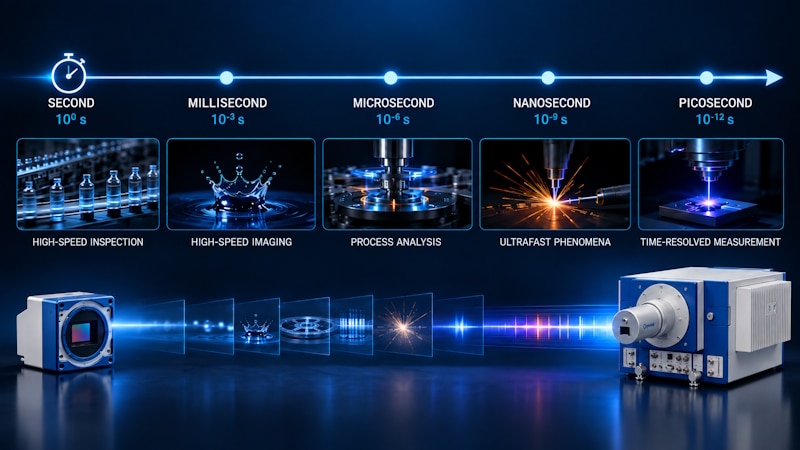
When even a single photon and a picosecond matter
1 photon
How do you measure light when there is almost none?
In 1986, development of the “OptoScope” streak camera system began in earnest, leading to its market readiness. This made it possible to detect and count individual photons. Extremely faint optical events could be reliably made visible. The key was not just “seeing” something, but being able to measure it.
5 picoseconds
What happens if even a nanosecond is too imprecise?
The “OptoScope” streak camera not only enabled the measurement of extremely weak signals but also their duration. It records time with a resolution down to the picosecond range—that is, one millionth of a millionth of a second. In ultra-fast optical measurements, even the slightest temporal jitter can compromise measurement results. From the very beginning, Optronis developed its streak systems with a focus on temporal stability.
02 – When a Moment Is Too Fast for the Eye to Catch
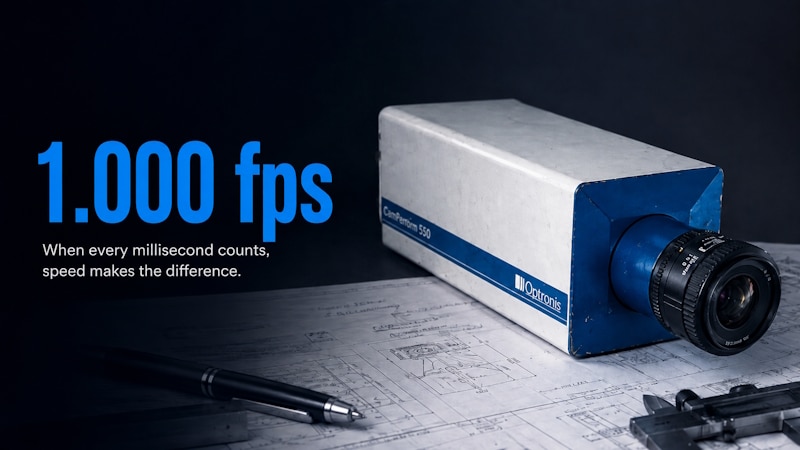
1996: 512 × 512 PIXELS. 1,000 FRAMES PER SECOND.
When development began in Germany in 1996, machine vision was still in its infancy. Analog cameras and frame grabbers dominated the market. There was not yet a suitable interface for electronic high-speed cameras that could continuously transmit large amounts of image data. For this reason, the images were initially stored internally.
One of the first Optronis cameras captured 512 × 512 pixels at 1,000 frames per second. Today, that seems almost modest. Back then, it meant that a fast process—of which perhaps only the beginning and end had been visible before—could be examined frame by frame for the first time.
Even back then, it wasn’t about speed as an end in itself. High-speed imaging became a tool for troubleshooting, process monitoring, and technical understanding. A single moment became data. And data became understanding.
03 – 2011:
Taking pictures was only half the solution
RECORD → TRANSFER → PROCESS
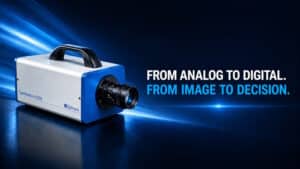 Early high-speed cameras primarily operated on the following principle: capture, store internally, read out, and then analyze. This is not sufficient for industrial machine vision. In this context, image data must be continuously delivered to where it is processed—quickly, reliably, and with predictable timing.
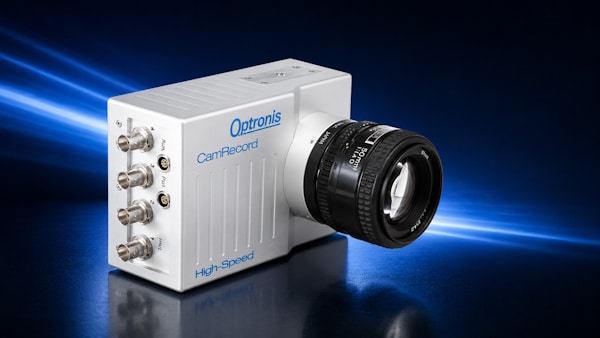
Early high-speed cameras primarily operated on the following principle: capture, store internally, read out, and then analyze. This is not sufficient for industrial machine vision. In this context, image data must be continuously delivered to where it is processed—quickly, reliably, and with predictable timing.
The question “What just happened?” increasingly became: “What is happening right now—and how can the system respond to it?” High-speed imaging became high-speed machine vision.
04 – Then / Now:
Almost everything has changed. But our mission hasn’t.
THEN
512 × 512 px
1,000 fps
internal memory
Analysis afterward
Capture fast-moving events
NOW
High-resolution sensors
Extremely high data rates
Continuous transmission
Machine vision / real-time integration
Provide reliable image data
What remains? Reliably capturing the decisive moment.
05 – today:
High speed is more than just frame rate
WHAT HAPPENS WHEN CAMERAS CAN SEE MORE AND MORE?
MORE AND MORE DATA IS BEING GENERATED.
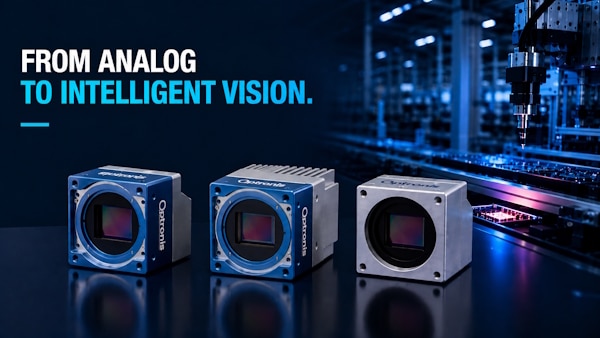
Modern sensors combine high resolution with high frame rates. This shifts the challenge: It is no longer enough to simply generate images quickly. The entire imaging system must deliver the resulting data reliably, reproducibly, and in a way that allows for integration.
This is exactly where today’s Optronis world comes in. CyclonePlus and CycloneFiber represent high-speed machine vision with high bandwidth, deterministic data transmission, and industrial integration capabilities. Standards such as CoaXPress, GenICam, and EMVA 1288 help make high-performance technology comparable, predictable, and easier to integrate.
HIGH BANDWIDTH
large amounts of image data
transmitted reliably
DETERMINISTIC DATA
predictable and stable
image data streams
MACHINE VISION READY
Developed
for industrial integration
06 – 2026:
The Next Chapter – Hurricane
100 Gb/s. 9 GPixels/s.
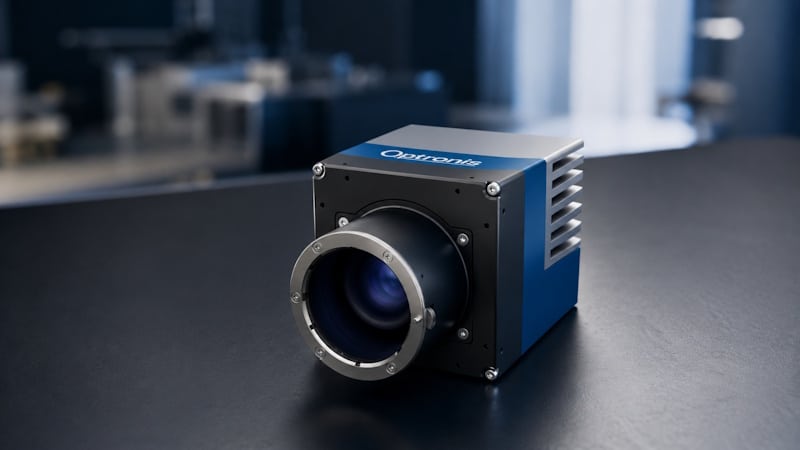
Sensors are getting faster. Resolutions are increasing. Applications demand more and more image data in ever-shorter periods of time. This raises essentially the same technical question today as it did decades ago—only on a completely different scale: How can we manage ever-larger volumes of image data in a way that ensures the decisive moment remains reliably measurable?
With Hurricane, Optronis is opening the next chapter in high-speed machine vision at VISION 2026. The new generation of cameras supports data rates of up to 100 Gb/s and up to 9 GPixels/s—marking a logical continuation of a development that has been at the heart of Optronis’s work for decades: making fast processes visible and reliably delivering the resulting image data.
“The customer should receive the image data that their application requires—even if they aren’t a specialist in camera technology themselves.”
Technology changes. Our commitment remains the same.
- Capture fast processes.
- Provide reliable image data.
- Make technology understandable and usable.
30 Years of Optronis Germany.
40 Years of Technological Roots.
MAKE TIME VISIBLE.
Dr. Patrick Summ, Managing Director

Groundbreaking Innovations
We have been at the forefront of ultra-high-speed optical measurement technology since 1986. As an active market partner, we also consider it our mission to further develop technologies and application methods. In doing so, we have achieved lasting success and actively shaped technologies and trends. With Optronis products, you can rely on proven yet state-of-the-art technologies.