No AI Can Detect a Defect That Was Never Captured
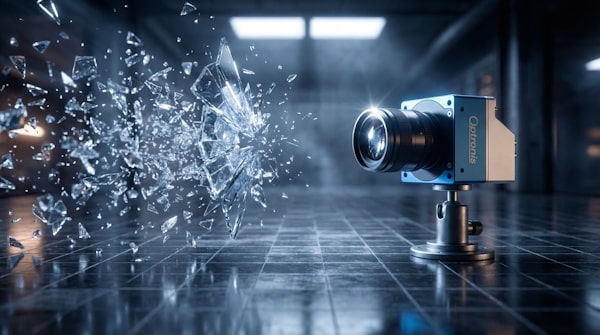
Why deterministic imaging is becoming the foundation of reliable quality inspection
Manufacturers across Europe are investing heavily in AI-driven inspection systems. Yet many quality-control projects overlook a fundamental limitation: AI cannot compensate for missing image data.
In high-speed production environments, synchronization errors, dropped frames, and unstable data streams can prevent critical defects from ever reaching the inspection system. Once information is lost during image acquisition, no algorithm can recover it.
This challenge is becoming increasingly relevant in semiconductor manufacturing, electronics production, battery manufacturing, and advanced automation environments where production speeds, throughput requirements, and inspection complexity continue to increase.
To address these challenges, Optronis develops imaging systems specifically designed for applications where conventional machine vision architectures reach their limits.
The CyclonePlus series combines high frame rates with resolutions of up to 65 megapixels, enabling reliable inspection of fast-moving processes while preserving critical image detail. For distributed inspection systems and large-scale production environments, the CycloneFiber series provides deterministic image transmission via high-bandwidth fiber-optic connections, supporting stable synchronization and reliable data acquisition across complex multi-camera architectures.
The Real Challenge Is No Longer Frame Rate
For years, machine vision performance was largely defined by frame rate. Today, manufacturers are discovering that high frame rates alone do not guarantee reliable inspection results. The critical question is no longer how many images can be acquired per second. The real question is whether those images remain complete, synchronized, and available for analysis throughout the entire inspection process.
In modern manufacturing environments, even minor timing deviations, lost frames, or unstable data streams can compromise process transparency and create inspection gaps that remain invisible until quality issues emerge downstream.
Why AI Needs Deterministic Imaging
The rapid adoption of AI-based inspection systems further amplifies this challenge. Artificial intelligence can identify patterns, classify defects, and automate decisions at unprecedented scale. However, AI cannot compensate for incomplete image data, synchronization errors, or missing frames.
Reliable machine learning starts with reliable image acquisition
In many projects, significant effort is invested in training AI models, while comparatively little attention is paid to the quality and consistency of the underlying image data. Yet the quality of those data sets ultimately determines the quality of AI-driven decisions.
Inspection Must Move Beyond Frame Rates
As Europe continues to invest in semiconductor manufacturing capacity, advanced production technologies, and AI-enabled automation, inspection quality is becoming a strategic factor rather than a production detail.
The future of quality assurance depends on deterministic imaging architectures that ensure image data remains complete, synchronized, and actionable from acquisition to analysis.
Because in modern manufacturing, quality control does not fail when a defect occurs. It fails when the inspection system never sees the defect in the first place. And no AI system can detect a defect that was never captured.